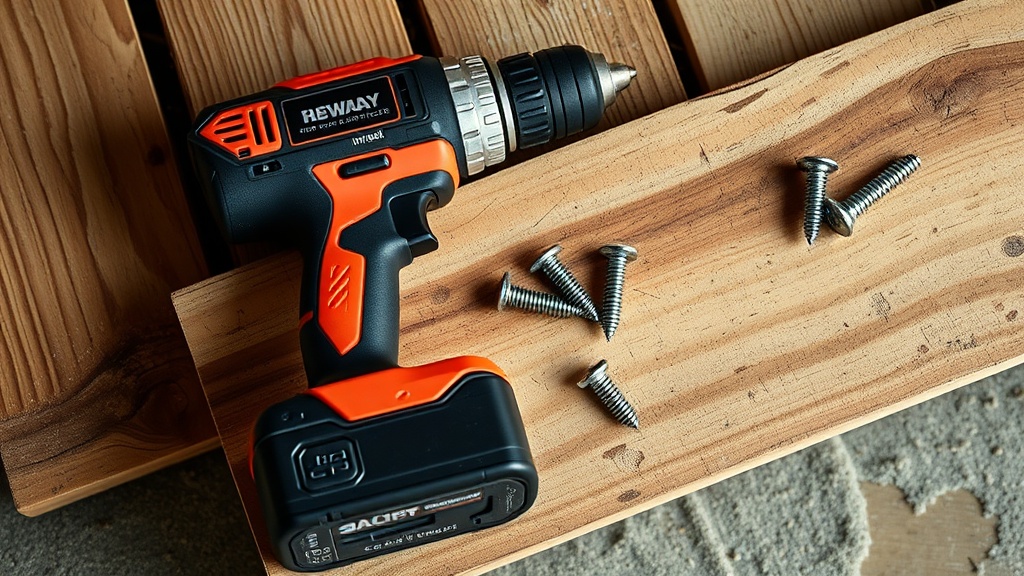
The First Power Tool to Own (And Why Everyone Gives You Wrong Advice)

Let's talk about the advice that keeps women stuck.
You've decided you want to own a power tool. Maybe it's International Women's Day this Sunday and you're feeling it. Maybe you've watched one too many shelves wobble while waiting for someone else to fix them. Maybe you're just done paying $80 for a furniture assembly "fee" on top of a $200 table. Whatever got you here — good. You're here.
And then someone, usually well-meaning, tells you: "Just get a basic drill."
Wrong. (Or at least, incomplete.)
The Problem With "Just Get a Drill"
A drill bores holes. That's it. Holes in walls, holes in wood, holes in your patience when you're trying to drive a screw and the clutch slips and the head strips and you're standing there covered in drywall dust wondering why you started this.
Drilling holes is not the primary thing you need to do in a home. The primary thing you need to do is drive fasteners — screws, into wood, into anchors, into furniture hardware, into deck boards, into cabinet hinges. That is the majority of what home repair actually is.
The tool for driving fasteners is an impact driver. Not a drill.
Here's the technical difference, because you deserve the actual explanation: A drill applies continuous rotational force. An impact driver adds rapid concussive blows — thousands per minute at full speed — which prevents cam-out (that's when the bit slips out of the screw head and ruins it). It also applies significantly more torque without requiring you to push as hard. For a smaller-framed person doing overhead work, that matters enormously. Why physical size and strength aren't the barrier — the impact driver does the work. You just guide it.
The "just get a drill" advice assumes you'll be drilling a lot of holes. For your first year of home projects, you will be driving a lot of screws. The advice is wrong for your use case.
What You Actually Need
An 18V brushless combo kit — one impact driver, one drill/driver — runs somewhere in the $130–$200 range from Milwaukee, DeWalt, or Makita (check current pricing; sales are frequent). Two batteries, a charger, a case. You'll use both tools, just with the impact driver doing the heavy lifting on most days.
Buy the combo. Don't buy them separately. The batteries are interchangeable within the brand, and you will eventually need both.
Skip the 12V "compact" kits marketed with pink cases and phrases like "perfect for the home enthusiast." That language is telling you something. It's telling you the manufacturer thinks you don't need the real version. The 18V tools are not meaningfully heavier — a Milwaukee M18 FUEL impact driver comes in around 2.2 lbs. A can of soup is more work to hold overhead.
Three Things You Can Do This Weekend
1. Install floating shelves with proper anchors.
The difference between a shelf that holds weight and one that rips out of the wall with your grandmother's ceramic collection isn't the shelf — it's the anchor and the torque driving it in. A quality toggle bolt into drywall can hold a significant load per anchor point (ratings vary by bolt size and drywall condition — check the packaging). A screw you hand-tightened into nothing is holding approximately zero. The impact driver gets the anchor seated correctly. You will do this right the first time.
2. Disassemble and reassemble furniture for repair.
That wobbly dining chair? The mortise-and-tenon joints have failed, or the corner blocks have come loose. Disassembly is four to six screws. Glue, clamp, reassemble. An impact driver makes the re-tightening actually hold because you're achieving real torque. I've rebuilt four chairs this way that would have gone to the curb — and you can too.
3. Swap out cabinet hardware.
The landlord-special brass pulls that came with your kitchen cabinets? Six screws per door. One Saturday. Impact driver. There's a whole playbook for upgrading those landlord-special cabinets beyond just hardware. The mental model shift here is important: you will realize how easy it is to change things. That's the point.
On Injury Risk (The Real Conversation)
The hesitation isn't usually "I'll break the wall." It's "I'll break my hand." Let's be honest about what you're actually working with.
Impact drivers don't kick back the way circular saws do. They don't have spinning exposed blades. The realistic risk profile for a cordless impact driver is: you'll strip a screw head (annoying, fixable), you might overdrive a screw into soft wood (also fixable), and if you drop it on your foot it will hurt. That's the practical list.
Eye protection and hearing protection. Every time, no exceptions — not because the impact driver is particularly loud, but because you're building the habit now, before you work up to tools that require it more urgently. PPE is infrastructure, not heroics.
The documented high-severity DIY injuries cluster around ladders, circular saws, and table saws. A cordless driver is not in that category. The fear is real and it was put there by a culture that decided power tools were masculine and therefore dangerous-by-association for anyone else. The tool doesn't know that.
The Permission Thing
You don't need a class. You don't need a man present. You don't need a home improvement store's "ladies' clinic" on Saturday mornings (the condescension is free with purchase). You need:
- One YouTube video (any reputable contractor channel, 10–15 minutes)
- The right tool
- One project with low stakes — an interior shelf, a cabinet handle, a piece of furniture that's already broken
That's it. That's the whole gateway.
I built a van into a functional home with a $600 set of tools I learned to use by breaking things and watching video. The confidence came after the first project, not before. You cannot think your way into it. You have to build something. Once you do, you'll be amazed how a few core carpentry skills solve problems you thought were permanent.
International Women's Day is March 8 — this Sunday. The best thing I can tell you is this: there is no category of home repair you are physically or cognitively incapable of learning. The tools don't know who's holding them. The wood doesn't care. The only thing that makes a project yours is deciding to start.
Your first power tool purchase is not a statement. It's a decision to stop waiting.
Make the decision.
— Sloane