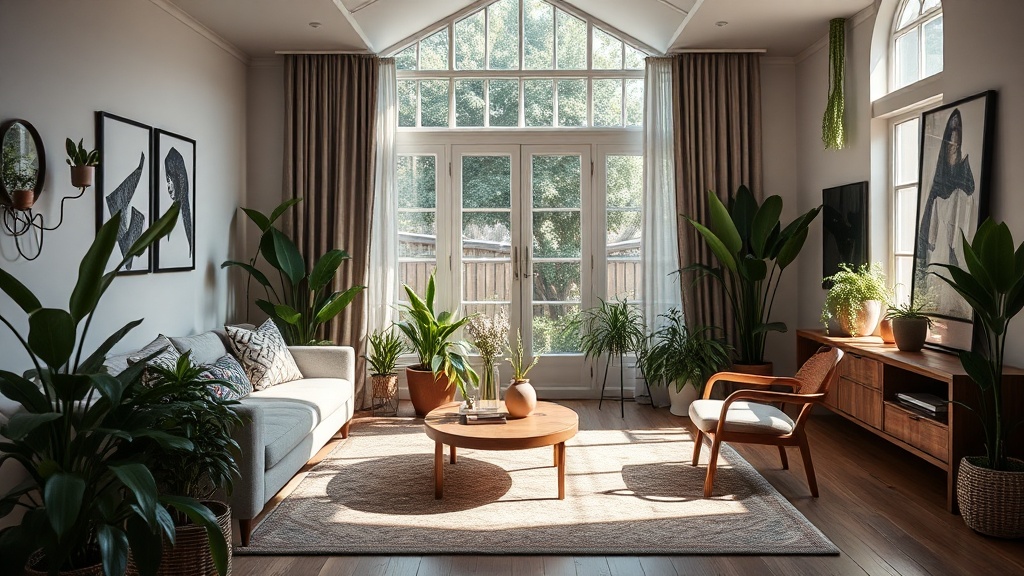
Ways to Use Indoor Plants to Soften Your Living Room

A living room with high ceilings, sharp-angled mid-century modern furniture, and polished concrete floors often feels visually striking, but it can also feel cold and uninviting. The hard surfaces reflect sound and light in ways that strip a room of its warmth, making the space feel more like a gallery than a home. Adding indoor plants is a strategic design move used to break up these rigid lines and introduce organic textures that soften the overall aesthetic. This post explores how to use plant placement, scale, and varying heights to transform a sterile living area into a balanced, comfortable space.
Use Scale to Break Up Verticality
One of the most common mistakes in interior design is using small, scattered plants that fail to make a visual impact. In a room with high ceilings or large, empty wall segments, a tiny succulent on a side table does nothing to soften the architecture. To effectively break up vertical space, you need "statement plants" that command attention and draw the eye upward.
A large Ficus Lyrata (Fiddle Leaf Fig) or a Strelitzia Nicolai (Giant Bird of Paradise) serves as a living sculpture. These plants have broad, structural leaves that provide a heavy visual weight, which helps ground a room with high ceilings. Position these in corners where two hard lines—such as a wall and a floor—meet. This obscures the sharp 90-degree angle and introduces a curved, organic silhouette. If you have a large, empty corner near a window, a tall Dracaena can act as a natural pillar, softening the transition between the floor and the ceiling.
When selecting a large-scale plant, consider the "footprint" of the pot. A heavy ceramic or stone planter adds a sense of permanence and stability. Avoid lightweight plastic pots for large plants, as they can look flimsy and fail to provide the visual "anchor" required to balance a large room. If you are working with a limited budget, look for high-quality artificial trees from retailers like West Elm or even local nursery clearance sections, as the visual impact of the greenery is more important than the biological life of the plant in this specific design context.
Create Layers with Varyity in Height
A well-designed room uses layers to create depth. In a living room, you can achieve this by grouping plants at different elevations. Rather than placing every plant on the floor or every plant on a shelf, you should create a "staircase" effect that leads the eye through the space.
- Floor Level: Use large, bushy plants like a Monstera Deliciosa to create a base layer.
- Mid-Level: Utilize coffee tables, plant stands, or even custom floating shelves to host medium-sized plants like Zamioculcas zamiifolia (ZZ Plant) or Sansevieria (Snake Plant).
- High-Level: Use trailing plants on top of bookcases or high mantels to allow greenery to spill downward, blurring the lines between furniture and the ceiling.
The goal is to avoid a single horizontal line of greenery. By varying the heights, you create a sense of movement. For example, if you have a long sideboard or a media console, don't line up five identical pots. Instead, place one tall plant on one end, a medium-sized trailing plant like a Pothos in the center, and a low-profile bowl of succulents on the other. This creates a dynamic, natural silhouette that mimics how plants grow in the wild.
Introduce Soft Textures via Foliage
The texture of the leaves themselves can change the "mood" of a room. In a room filled with hard materials like leather, metal, or glass, you want to select plants with textures that provide a direct contrast. This is a matter of visual weight and tactile perception.
If your furniture is sleek and minimalist, such as a velvet sofa or a glass-topped coffee table, choose plants with highly textured or "busy" foliage. A Calathea with its intricate, patterned leaves provides a much-needed organic detail that breaks up the monotony of smooth surfaces. Similarly, a Fern (such as a Boston Fern) offers a soft, feathery texture that can visually "quiet" a room with sharp, industrial edges. The fine, delicate fronds of a fern act as a visual buffer, making the space feel much more breathable.
Conversely, if your room is filled with heavy, textured fabrics like chunky wool throws or linen curtains, you might opt for plants with large, smooth, and waxy leaves. A Rubber Tree (Ficus elastica) or a Philodendron offers a clean, polished look that complements heavy textiles without adding unnecessary visual "noise." Understanding this balance between leaf shape and furniture texture is key to a cohesive design.
Use Plants to Define Functional Zones
In open-concept living areas, the transition between the living room and the dining area or home office can often feel abrupt. Plants can act as "soft dividers" that define these zones without the need for heavy walls or permanent partitions. This is a technique often used in studio apartments to create psychological separation between work and relaxation.
For instance, if your living room flows directly into a workspace, placing a row of tall Sansevieria (Snake Plants) or a long, low planter box can create a visual boundary. This creates a "green wall" effect that signals to your brain that you are moving from a social space to a focused environment. This is particularly effective if you want to organize your home office for better focus, as the greenery provides a natural visual break from computer screens and office equipment.
You can also use plant clusters to "frame" a seating area. If you have a sectional sofa, placing a large plant near the end of the sofa helps to "close" the seating area, making it feel more intimate and protected. This creates a sense of enclosure and coziness, which is essential for a space intended for relaxation.
Practical Considerations: Light and Maintenance
A design plan is only successful if it is sustainable. There is nothing that ruins a curated living room aesthetic faster than a collection of dying, yellowing leaves. Before you purchase your greenery, you must perform a "light audit" of your living room. Use a light meter app on your phone or simply observe the room at different times of the day.
Direct Sunlight: If your living room has large, south-facing windows, you have high-light areas. This is the perfect spot for Cacti, Succulents, or Bird of Paradise. These plants thrive in the intense light and will add a structural, desert-inspired aesthetic to your room.
Indirect/Low Light: If your living room is north-facing or tucked away from windows, you need "low-light tolerant" plants. Pothos, ZZ Plants, and Peace Lilies are incredibly resilient and can thrive in the shadows. These are ideal for placing on bookshelves or in corners where the light levels drop significantly.
Humidity and Airflow: If your living room has a fireplace, the air will likely be dry during the winter months. Plants like Ferns or Calatheas require higher humidity and may struggle in a room with constant heat. In these cases, consider using a pebble tray or a small humidifier nearby to maintain the plant's health. Always check the drainage of your pots; a plant sitting in stagnant water will develop root rot, which is a fast way to lose your design investment.
"Design is not just about what you add; it is about how the elements interact. A plant is not just a decoration; it is a structural tool used to manipulate light, shadow, and texture."
By treating your indoor plants as architectural elements rather than just accessories, you can use them to master the balance of your living room. Whether you are using height to draw the eye upward or texture to soften a hard edge, the addition of greenery is one of the most effective ways to turn a house into a home.