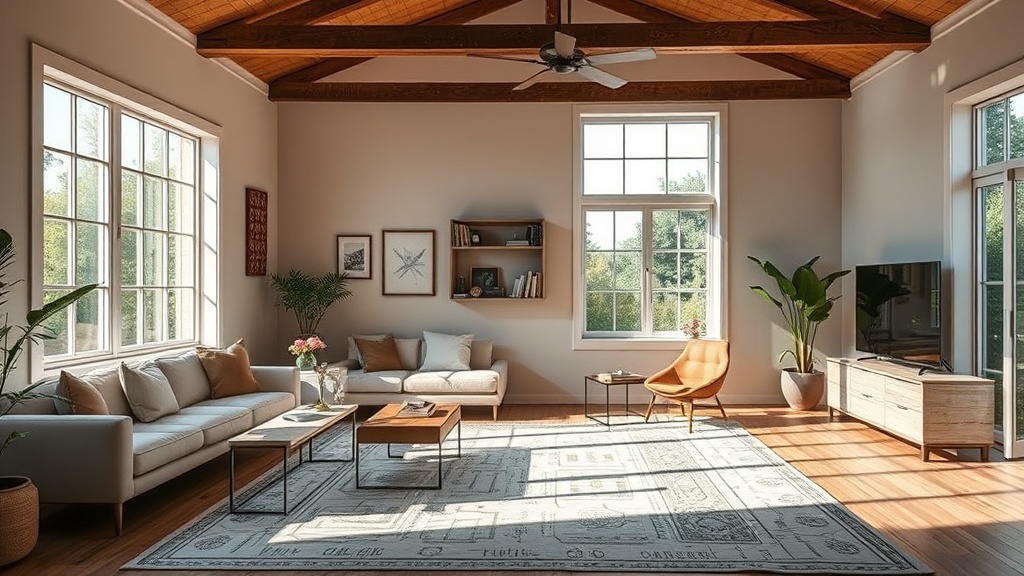
Why Your Floor Plan Feels Off and How to Fix the Layout

The Math Behind Movement and Space
Nearly 70% of people living in homes with small or medium-sized floor plans report feeling a sense of "clutter fatigue," even when their surfaces are clean. This isn't always about having too much stuff; often, it is a structural failure of the layout. When a room's circulation paths are blocked or the scale of the furniture contradicts the architectural footprint, the brain perceives it as a problem to be solved. This post covers how to diagnose these spatial bottlenecks and reorganize your room using architectural principles rather than just moving furniture around for the sake of it.
In my previous life, I spent years staring at blueprints where every millimeter was accounted for. Now, I look at a living room and see the same thing: a series of vectors and clearance zones. If your sofa is sitting three inches too far from the coffee table, or if you have to do a weird side-shuffle to get past a dining chair, your room is failing the circulation test. We're going to look at how to fix that through intentional design math.
Will a New Layout Actually Make My Room Feel Bigger?
The short answer is yes, but not by adding more light or painting walls white. You do it by increasing the "perceived volume" of the room. This happens when you create clear, unobstructed pathways. A common mistake is pushing every single piece of furniture against a wall. While this creates a large empty space in the middle, it often makes a room feel hollow and unanchored. Instead, try pulling furniture away from the perimeter to create a central "anchor" zone.
Think about your "primary circulation path." This is the main highway through a room. If your sofa is a roadblock on the way from the kitchen to the balcony, the room will always feel cramped. You want to leave at least 30 to 36 inches for main walkways. If you can't achieve that, your furniture is too big for the space. Use a tape measure—don't guess. If your current layout forces you to weave through obstacles, it's time to redraw the lines.
The Rule of Three Clearances
To get the math right, you need to respect these three standard architectural clearances:
- Coffee Table to Sofa: Aim for 14 to 18 inches. Any closer and you'll hit your shins; any further and the table feels disconnected.
- Dining Chair to Wall: You need at least 36 inches behind a chair to allow someone to pull it out and stand up without hitting the wall.
- Rug Borders: A rug shouldn't be a floating island. It should either be large enough for all furniture legs to sit on it, or at least the front legs of your seating-group to touch it.
If you're looking for more technical standards on residential spacing, the Architectural Digest archives often discuss how scale affects the feel of a room. You can also check out the Dwell database for modern layout inspiration that emphasizes open flow.
Can I Fix a Bad Room Layout Without Buying New Furniture?
Most of the time, you don't need a new sectional; you just need to rotate your perspective. The most effective way to test a layout is the "viewpoint method." Stand in the doorway of the room and look at the focal point. Is your eye drawn to a beautiful window or a blank wall? If it's a blank wall, your furniture is likely fighting the architecture. Reorient your seating to face the natural focal point of the room.
Try the "Zoning Technique." In open-concept living, rooms often feel like a messy soup of functions. You need to create invisible walls using furniture. A console table behind a sofa or a low bookshelf can act as a physical boundary between the dining area and the lounge area. This provides a sense of enclosure and order that a single, large room lacks.
How Do I Choose the Right Scale for My Furniture?
Scale is the relationship between an object and the space it occupies. A massive, heavy oak sideboard in a narrow hallway will make the hallway feel like a tunnel. Conversely, a tiny end table next to a giant velvet sofa will make the sofa look like a mountain. To avoid this, look at the "negative space" around your objects.
Before you move anything, grab a piece of graph paper. Draw your room to scale—1 square equals 1 foot. Then, draw your furniture as blocks. This is a classic architectural trick to see if your plan actually works before you break a sweat moving heavy objects. If the blocks look crowded on the paper, they will feel suffocating in real life. You'll see immediately if a rug is too small or if a bookshelf is hogging too much visual real estate.
Don't forget to account for the "verticality" of your room too. If you have low ceilings, avoid tall, heavy bookshelves that might feel like they're leaning over you. If you have high ceilings, use tall elements like floor lamps or high-set art to draw the eye up, making the room feel more balanced and less bottom-heavy.