The Used Furniture Buying Guide Nobody Taught You: An Architect's 60-Second Structural Check

I fixed a wobbly dresser this morning. Yesterday I prepped and painted a bookcase. Both pieces cost me under $40 on Facebook Marketplace. And both almost didn't make it into my van because I nearly passed on them — they looked rough in the listing photos, and the sellers described them as "needs some love," which is Marketplace code for "I have no idea if this thing is worth saving."
Here's the thing: most people scroll past the pieces worth rescuing and overpay for the ones that look "nice" in photos but are structurally dead on arrival. They're buying particle board covered in vinyl wrap, held together with staples and prayers, because the listing had good lighting.
I've bought over 200 pieces of secondhand furniture in the last six years. I've hauled home maybe 15 genuine mistakes. The rest? Solid wood, real joinery, pieces that just needed cleaning, tightening, or a proper finish. The difference isn't luck — it's knowing what to look at before you hand over cash.
The 60-Second Structural Check (Do This in the Driveway)
You don't need to bring a moisture meter to a stranger's garage. You need your hands and about one minute.
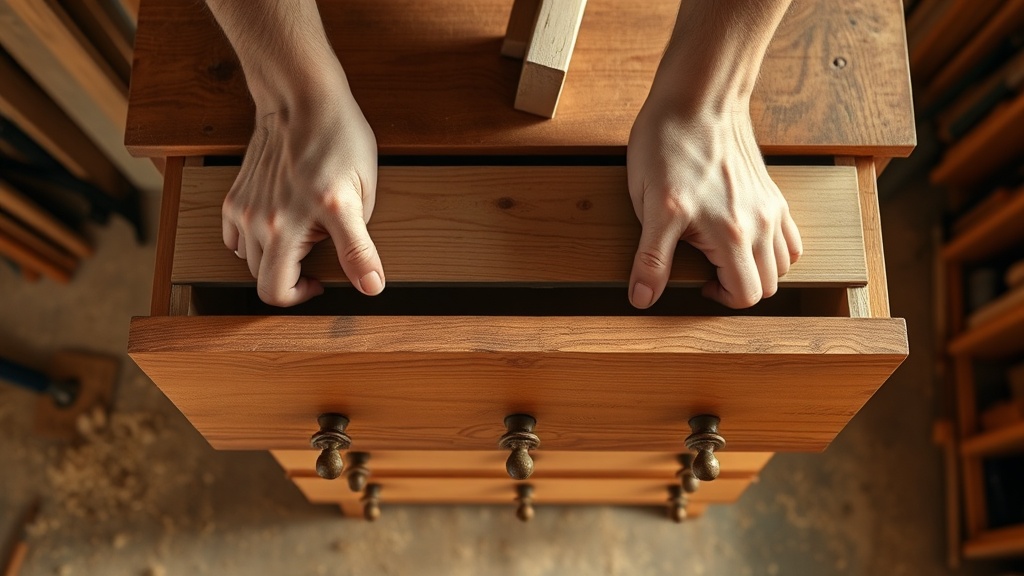
1. Flip it over. I don't care if the seller gives you a look. The underside of furniture tells you everything the top won't. You're looking for:
- Corner blocks: Triangular wood pieces glued and screwed into inside corners. If they're there, someone built this to last. If the corners are empty or have dried-out hot glue? Walk.
- Joinery type: Dovetails on drawer boxes = real furniture. Stapled butt joints = disposable furniture wearing a costume. Mortise-and-tenon on chair legs = buy it immediately and thank the universe.
- Dust panel between drawers: A thin wood panel separating each drawer cavity. Only quality case goods have these. It's like finding load-bearing walls in a building — it means someone engineered the thing.
2. Rack it. Grab the top of a dresser or bookcase and push it sideways. Does the whole thing shift like a parallelogram? That's called "racking," and it means the joints have failed or were never there. A little wobble in a 40-year-old piece is fixable — I literally wrote about this today. But if a piece racks with zero resistance, the internal structure is gone and you're looking at a rebuild, not a repair.
3. Knock on it. Solid wood sounds dull and dense. Particle board sounds hollow, like knocking on a hotel room door. MDF is somewhere in between — denser than particle board but still hollow compared to real timber. This takes practice, but after three or four purchases, your knuckles will know the difference before your brain catches up.
The Five Red Flags That Mean "Keep Scrolling"
Not everything deserves to be saved. I know that's hard to hear from someone who rescues sad furniture for a living, but some pieces are structurally hospice and no amount of wood glue will bring them back.
Red Flag #1: Swollen edges. When particle board gets wet, it puffs up like a sponge and never goes back. You'll see this on the bottom edges of bathroom vanities, the feet of kitchen carts, and the undersides of dressers that lived in basements. Once particle board swells, it has lost all structural integrity. You cannot sand it flat. You cannot seal it. It's done.
Red Flag #2: Stripped cam locks. Those little metal discs and bolts that hold flat-pack furniture together? They're designed for exactly one assembly. Maybe two if you're gentle. If you're buying a used IKEA piece and the cam locks are stripped or spinning freely, the piece will never be tight again. I make an exception for IKEA pieces with actual dowel joinery (the HEMNES line, for example) — but the cam-lock-only stuff has a hard expiration date.
Red Flag #3: Delaminating veneer with particle board underneath. Veneer over solid wood? Totally fine — that's how furniture was built for centuries. Veneer over plywood? Still good. Veneer peeling off particle board? That piece is a ticking clock. Once moisture gets under the veneer, the substrate disintegrates. And you can't just re-veneer particle board. The surface is too inconsistent to get a clean bond.
Red Flag #4: "Solid wood" listings with no photos of the underside. If someone claims solid wood and won't show the bottom of drawers or the back panel, they either don't know or they're hoping you won't check. I always ask for underside photos before I drive anywhere. Saves gas, saves time, saves the uncomfortable moment of telling someone their "antique" dresser is a 2009 Target purchase.
Red Flag #5: Cigarette smoke or pet urine saturation. This is a structural issue, not just an aesthetic one. Urine breaks down wood fibers over time, especially in unfinished areas like drawer interiors. And smoke doesn't just sit on the surface — it penetrates deep into the grain. You can seal and refinish the exterior, but every time you open a drawer, it's coming back. I've tried every deodorizing trick in the book. Some work temporarily. None work permanently on heavily saturated pieces.
What I Actually Look For (The Buy Signals)
Forget "mid-century modern" and "farmhouse charm" as search terms. Here's what I type into Marketplace when I want to find pieces worth my time and gas money:
"Solid wood dresser" + your city. Obvious, but you'd be surprised how many people don't specify.
"Grandma's furniture." I'm dead serious. Search "grandma" or "estate sale" or "downsizing." The best furniture on Marketplace comes from people clearing out homes where pieces have sat in the same spot for 30+ years. That dresser survived three decades of daily use? It's got better bones than anything at West Elm.
"Needs refinishing." This is where the deals live. A solid maple dresser with an ugly stain gets passed over by everyone who wants "move-in ready." I see a $40 piece with $200 worth of structure underneath. Add $50 in supplies and some weekend hours, and you've got a piece that'll outlast you.
Here's my actual checklist — what makes me say yes:
- Dovetailed drawer boxes (hand-cut or machine-cut, both good)
- Solid wood drawer bottoms (not hardboard)
- Center drawer glides (metal or wood — both indicate quality)
- Solid wood back panel (not that thin cardboard stuff stapled on)
- Weight. Good furniture is heavy. If you can lift a full dresser with one hand, it's not solid wood.
- Manufacturer stamp or burn mark inside a drawer. Ethan Allen, Drexel, Thomasville, Henredon, Stanley, Broyhill (older pieces), Lane — all worth grabbing if the price is right.
The Price Math Nobody Does
Here's the cost breakdown I keep in my spreadsheet (yes, I have a spreadsheet — her name isn't as catchy as Bernice, but she's equally important):
Used solid wood dresser: $30–80 on Marketplace
Repair supplies (wood glue, clamps, screws): $15–25
Refinishing (stripper, sandpaper, finish): $40–60
Total: $85–165 for a piece that will last another 30 years
New "solid wood" dresser from a DTC brand: $800–1,400
Actual material: Usually engineered wood with a veneer face
Lifespan: 5–10 years before the drawer glides fail or the cam locks strip
Repairability: Low to zero
I've done this math enough times that it makes me physically uncomfortable to walk through furniture showrooms. You're paying a 10x markup for inferior materials and a photograph-friendly finish that won't survive a toddler.
The Negotiation Part
Don't be weird about it. Don't lowball people. But here are the two things that consistently get me 20–30% off asking price:
"I can pick it up today." Sellers want stuff gone. The number one frustration on Marketplace is people who say "interested!" and then ghost. If you can show up within a few hours with cash, you have leverage.
"I notice [specific issue]. Would you take $X?" Point out the actual repair needed — a loose leg, a missing knob, a water ring. Don't insult the piece. Just be honest about what work it needs. Most sellers are relieved someone actually looked at it closely and aren't trying to return it in two days.
My Last Five Marketplace Wins
Just so this isn't all theory:
- Drexel Campaign dresser, 1970s: $60. Needed new drawer glides and a light sanding. Worth approximately $600 refinished.
- Solid maple Ethan Allen nightstands (pair): $40 for both. Just needed cleaning. Literal theft.
- Oak dining table, no brand, hand-built: $75. Wobbled because one stretcher joint had failed. $8 in wood glue and dowels. Now seats six every Sunday.
- Thomasville bookcase: $25. The original dark stain was "out of style." I stripped it, hit it with natural Danish oil, and it looks like it costs $900.
- Stanley dresser, water-damaged top: $20. Cut a new top from a salvaged butcher block slab. Total cost with hardware: $65. It's in my van right now.
The furniture most people throw away is the furniture worth keeping. The furniture most people buy new is the furniture that'll be in a landfill in seven years. That's the entire thesis of this blog, and if today's post doesn't prove it, the dresser in my van does.
Go flip some furniture over. Your knuckles will thank you.