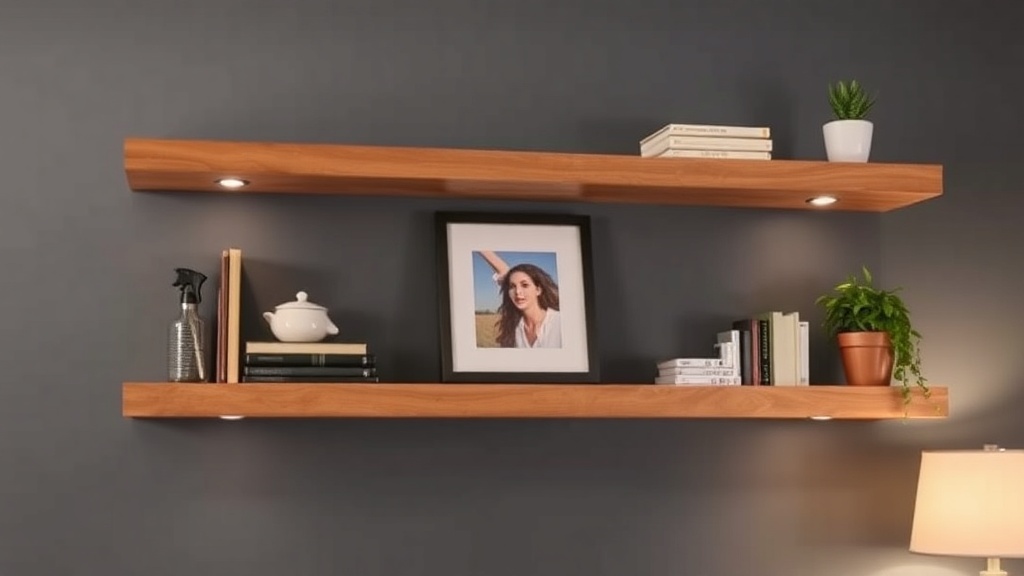
How to Build Custom Floating Shelves That Look Like a Pro Did It

This post walks through building custom floating shelves from raw lumber to wall-mounted finish—covering hidden bracket systems, load-bearing calculations, wood selection, and the finishing techniques that separate amateur hour from built-in quality. Floating shelves add storage without visual weight, but the gap between "nailed up a plank" and "custom millwork" comes down to understanding structural basics and refusing to skip the details that matter. You'll learn how to calculate span limits, select hardware that won't fail, and apply finishes that look like they came from a pro shop.
What tools do you need to build floating shelves?
You'll need a circular saw (or miter saw), drill/driver, level, stud finder, and a router with a roundover bit for edges. The catch? A pocket hole jig like the Kreg K4 helps with temporary support cleats, though hidden bracket systems eliminate visible fasteners entirely.
Don't overthink the tool list. A $79 Ryobi circular saw cuts lumber just fine for this project. What matters more is blade quality—swap the stock blade for a 40-tooth Freud Diablo finish blade (about $35 at Home Depot) and the cut quality jumps dramatically. Clean cuts mean less sanding, and less sanding means you're more likely to actually finish the project.
For drilling the blind holes that receive floating shelf brackets, a drill guide or drill press ensures straight entry. Hand-drilled holes at angles cause shelves to sit crooked—no amount of caulk fixes that. The Rockler Self-Centering Drill Bit set (around $25) removes the guesswork for hardware placement.
How do you hide floating shelf brackets for that seamless look?
Hidden floating shelf brackets—also called blind shelf supports—mount to studs or blocking in the wall, then slide into drilled holes in the shelf itself. The bracket remains invisible, creating that "how is that even attached?" effect that defines professional floating shelves.
Two main bracket types dominate the market. Here's how they compare:
| Bracket Type | Best For | Weight Rating | Price Range |
|---|---|---|---|
| Blind shelf supports (like Rockler's Heavy-Duty) | Standard drywall/stud walls | 25-50 lbs per bracket | $12-18 each |
| Floating shelf rods (like Mockett FM-Rod) | Tile or solid surface mounting | 40-75 lbs per rod | $15-25 each |
| Custom steel hidden brackets | Heavy loads, custom spans | 100+ lbs when engineered | $30-60 each |
The math matters here. A 36-inch shelf needs at least two brackets—three if you're storing books or heavy objects. Brackets should enter the shelf at least 75% of the shelf depth for stability. That means a 10-inch deep shelf needs 7.5-inch minimum bracket penetration.
Here's the thing about drywall: it can't support floating shelves. Period. You must hit studs or install horizontal blocking between studs during construction (or open the wall and add it). A bracket anchored only in drywall pulls out within months—sometimes weeks.
What's the best wood for floating shelves that won't sag?
Hardwoods like white oak, maple, and walnut resist sagging far better than softwoods like pine or construction-grade 2x material—though properly sized softwood can work for lighter loads. The key variable isn't just wood species; it's the span-to-depth ratio and how the shelf is supported.
For shelves under 30 inches, 3/4-inch thick material works if properly supported. Beyond 30 inches, you need 1.5-inch (effectively 2x) thickness or built-up edges that create the illusion of mass while saving weight and material cost.
Worth noting: big-box "whitewood" (usually spruce or fir) costs half what oak does but sags visibly at 36-inch spans under normal book loads. If budget forces softwood, keep spans under 24 inches or add a decorative front edge strip that doubles as a stiffener. A 1x2 oak strip glued and screwed to the front edge of a pine shelf adds surprising rigidity.
Reclaimed lumber looks fantastic—old barn beams, factory flooring—but check for embedded metal (nails, bolts) before cutting. A circular saw hitting a hidden nail destroys the blade and creates a safety hazard. Metal detectors exist for this reason; the Zircon MetalliScanner (about $50) pays for itself the first time it prevents a trip to the ER.
How much weight can floating shelves actually hold?
Properly installed floating shelves with hidden brackets can hold 25-75 pounds per bracket when anchored into studs or solid blocking—meaning a three-bracket shelf can safely support 75-225 pounds distributed evenly. The failure point is almost never the bracket itself; it's the wall attachment or the shelf material tearing around the bracket hole.
Calculate deflection (sag) before building. The WoodBin Sagulator (free online calculator) lets you input wood species, dimensions, and load to predict how much a shelf will droop. Anything under 0.02 inches per foot is invisible to the eye; over 0.1 inches looks broken even if it's structurally sound.
That said, most DIY floating shelf failures happen at the bracket-to-wall connection. Toggle bolts through drywall into hollow space can't handle cantilever loads—those brackets will pull out. The only reliable method is direct stud mounting or horizontal blocking installed during wall construction. Retrofitting blocking requires opening the drywall, but it's the difference between shelves that last decades and shelves that dump your grandmother's china.
Step-by-step: from lumber to finished installation
1. Cut and mill the shelves
Rip lumber to width on the table saw (or have the lumber yard do it—most will rip for $0.50 per cut). Cross-cut to length. Sand through grits: 80, 120, 180. The jump from 120 to 180 matters—it's what removes the scratch marks that telegraph through finish.
2. Drill blind holes for brackets
Mark bracket locations on the wall first—use a level and mark stud centers. Transfer those measurements to the back of the shelf. Drill holes square to the back face; angled holes mean crooked shelves. Use masking tape on the drill bit as a depth stop—drill 1/8 inch deeper than bracket length to allow for dust and slight variations.
3. Finish before installation
Finish all faces—including the back and bottom—before mounting. You'll never get proper coverage on the underside once it's on the wall. For wood-grain showcase, use three coats of Waterlox Original Sealer/Finish (tung oil and resin blend), sanding lightly between coats. For painted shelves, prime with Zinsser BIN shellac-based primer, then two coats of Benjamin Moore Advance (waterborne alkyd that levels like oil paint).
4. Mount brackets and install
Drill pilot holes in studs—never rely on bracket screws to self-tap into dense framing lumber. Use a torpedo level to ensure each bracket is level with its neighbor; a 1/8-inch height difference across 36 inches creates visible tilt. Slide shelves onto brackets, check with a level, and if needed—drill small pin holes from the shelf bottom into the bracket to prevent sliding (fill with wood putty afterward).
5. The details that sell it
Caulk the top edge where shelf meets wall with paintable acrylic-latex caulk (DAP Alex Plus, white). Tool the bead with a wet finger—professional trim carpenters spend more time caulking than cutting. If the wall isn't perfectly flat (it never is), scribe the back edge of the shelf to the wall contour using a compass, then belt-sand to the line for a gap-free fit.
Lighting makes floating shelves read as intentional, not improvised. Battery-powered LED strips (the Philips Hue Lightstrip or cheaper alternatives from Amazon) mounted on the underside create ambient glow and eliminate the shadow line that makes shelves look tacked-on. Hardwired puck lights integrated into the shelf bottom are the pro move—requires electrical planning, but the result is built-in quality.
Floating shelves live or die by proportions. Standard depth is 10 inches—enough for books, dishes, or display objects. Visual weight increases with thickness; a 2-inch thick shelf reads heavy, while 1-inch reads delicate. Match thickness to room scale: thick shelves in rooms with 9-foot ceilings, thinner profiles in compact spaces. The spacing between shelves matters too—12 to 15 inches for books, 18 to 24 inches for display objects. Too tight feels cluttered; too loose looks accidental.
The final test: stand across the room and squint. If the shelf lines read as continuous horizontals that belong to the wall—not boxes stuck onto it—you've nailed it. That architectural thinking—proportion, alignment, material honesty—is what separates DIY projects from designer pieces. The tools and techniques are learnable. The patience to execute them properly—that's the real skill.