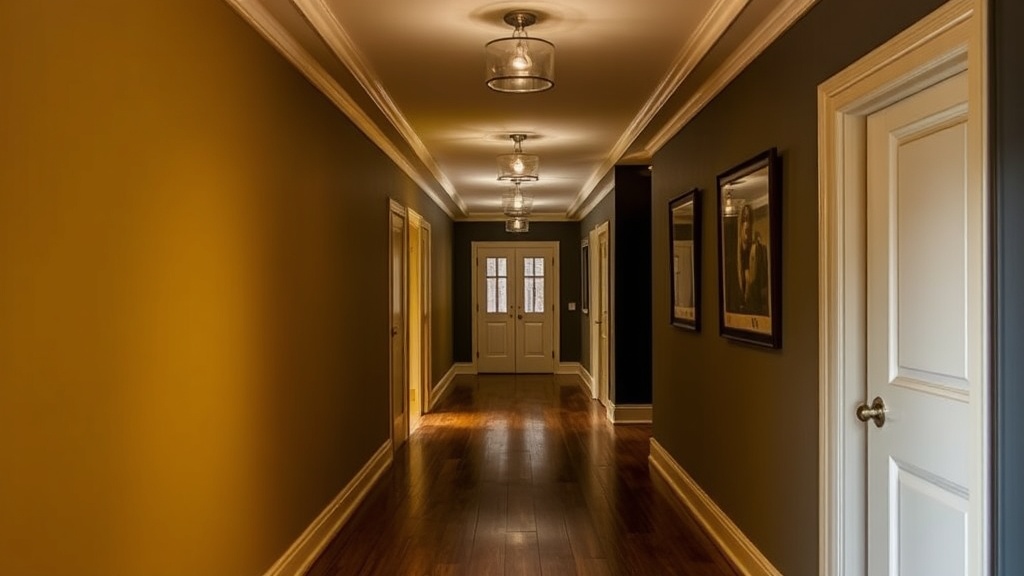
6 Ways to Brighten a Dark Hallway Without Renovation

Use Large Mirrors to Reflect Light
Swap Overhead Bulbs for Warm LEDs
Add Statement Wall Sconces
Choose Light-Reflecting Paint Colors
Incorporate Runner Rugs with Bright Patterns
Use Glass Decor Accents
A long, narrow hallway with no windows can feel like a tunnel, especially when the lighting is limited to a single, low-wattage overhead bulb. This architectural "dead zone" often becomes a place people rush through rather than inhabit. You don't need to tear down walls or install skylights to fix a dim corridor. By applying a few principles of light physics and visual weight, you can transform a dark passage into a bright, intentional transition space using paint, strategic lighting, and reflective surfaces.
1. Optimize Your Light Reflectance Value (LRV)
When choosing paint for a dark hallway, don't just look at the color swatch; look at the Light Reflectance Value (LRV) on the back of the paint chip. LRV is a scale from 0 to 100 that measures how much light a color reflects. A pure white might have an LRV of 90, while a deep navy might be as low as 5. In a windowless hallway, you want to target colors with an LRV of 70 or higher.
Avoid "stark" whites, which can actually look gray or dingy in low light. Instead, opt for "warm" whites or light neutrals with subtle undertones. For example, Benjamin Moore Simply White or Sherwin-Williams Alabaster provide enough warmth to prevent the space from feeling clinical, but enough brightness to bounce light back toward the center of the hall. If you want color, stick to pale pastels or "tinted" neutrals. A very light sage or a soft sand color will feel more intentional than a flat, muddy beige.
Remember that the ceiling is your largest horizontal plane. Painting the ceiling a slightly lighter shade than the walls—or using a high-quality flat white—helps "lift" the ceiling height, making the hallway feel less oppressive. Use a satin or eggshell finish on the walls to allow for a slight sheen that aids in light diffusion without the harsh glare of a high-gloss finish.
2. Layer Your Artificial Lighting
One single overhead light fixture creates harsh shadows and "pools" of light, leaving the corners of your hallway in total darkness. To brighten the space, you must layer your light sources. This means moving beyond the standard flush-mount ceiling light and incorporating multiple points of illumination.
Consider these three layers of lighting:
- Ambient Lighting: This is your base layer. If you can't change your ceiling fixture, swap a standard bulb for a high-lumen LED bulb with a "Warm White" color temperature (around 2700K to 3000K). Avoid "Daylight" bulbs (5000K+) in hallways, as they can feel blue and clinical in a confined space.
- Task/Accent Lighting: Use wall sconces to draw the eye upward and outward. If you aren't comfortable with hardwiring, look for "plug-in" sconces that can be mounted with simple screw-in brackets. This adds a rhythmic light pattern along the length of the hall.
- Accent Lighting: Use battery-operated LED picture lights above your artwork. This creates depth and makes the hallway feel like a curated gallery rather than a utility passage.
If your hallway is exceptionally long, a series of small, recessed-look puck lights or even a strategically placed floor lamp at the end of the hall can pull the eye forward, making the space feel more expansive.
3. Utilize Mirrors to Create Visual Depth
Mirrors are the oldest trick in the interior design playbook for a reason: they physically bounce light. In a narrow hallway, a mirror acts as a "virtual window." However, the placement and scale of the mirror are critical to avoid making the space feel cluttered.
Instead of several small, scattered mirrors, choose one large, impactful piece. A tall, leaning floor mirror at the end of a hallway can make the corridor appear to extend much further than it actually does. If the hallway is too narrow for a floor mirror, use a large horizontal mirror above a console table. This widates the perception of the walls.
When hanging a mirror, pay attention to what it reflects. If it reflects a dark corner or a cluttered closet door, it will only amplify the darkness. Position the mirror so it catches light from an adjacent room or a nearby doorway. A well-placed mirror can "steal" light from a bright living room and pull it into the dark hallway.
4. Incorporate Reflective Textures and Materials
Light doesn't just bounce off paint; it bounces off texture. To brighten a hallway, introduce materials that have a natural or manufactured sheen. This adds a layer of "specular reflection" that makes the space feel more dynamic.
Think about your furniture and decor choices through the lens of reflectivity:
- Metallic Accents: A brass or polished chrome tray on a console table, or metallic frames for your art, will catch whatever light is available and create small "glints" of brightness.
- Glass and Acrylic: A glass-topped console table or acrylic "ghost" chairs (if the hallway is wide enough for a seating area) are excellent because they don't block the line of sight. They allow light to pass through them rather than creating a solid shadow.
- Glossy Ceramics: A group of white or light-colored glazed ceramic vases can act as small light-reflecting sculptures.
Be careful not to overdo this. Too much high-gloss surface in a small space can create distracting glares. The goal is a balanced mix of matte walls and subtle, reflective accents.
5. Use Verticality and Art to Draw the Eye Upward
A dark hallway often feels low, even if the ceilings are standard height. You can combat this by using art to direct the eye vertically. This creates an illusion of height and airiness, which psychologically makes a space feel brighter.
When hanging art, avoid heavy, dark-framed pieces that "weigh down" the wall. Instead, use thin, light-colored frames (like light oak or white) and artwork with plenty of "negative space"—the empty areas around the subject. A landscape with a bright sky or an abstract piece with white backgrounds will feel much lighter than a dense, dark portrait.
You can also use a "vertical gallery" approach. Instead of a long horizontal line of pictures, hang art in a way that draws the eye up and down. This might mean a tall, narrow piece of art or a series of smaller pieces stacked vertically. This technique breaks up the monotony of the long walls and creates a sense of architectural interest that prevents the hallway from feeling like a closed-in tube.
6. Add Greenery for Life and Softness
While plants don't technically "emit" light, they add organic shapes and textures that soften the harsh lines of a hallway. A space with only hard surfaces and dark colors feels stagnant; plants introduce a sense of movement and life.
In a low-light hallway, you must choose plants that actually thrive in those conditions. Avoid high-maintenance tropicals and opt for "low-light champions." Excellent choices include:
- Snake Plants (Sansevieria): These have strong vertical lines that complement the architecture of a hallway and can handle very low light levels.
- ZZ Plants: These are nearly indestructible and feature glossy, dark green leaves that catch and reflect light beautifully.
- Pothos: If you have a shelf or a high console table, a trailing Pothos can soften the edges of the furniture and add a sense of cascading movement.
To make the plants look intentional, use high-quality planters. A white ceramic pot or a light-colored terracotta pot will look much brighter and cleaner than a dark plastic nursery pot. If you don't have any natural light at all, high-quality "real-touch" silk plants are a perfectly acceptable way to introduce color and organic shapes without the risk of losing a plant to neglect.
Transforming a dark hallway is about more than just adding more light; it's about managing how light interacts with your surfaces. By combining high-LRV paint, layered lighting, and reflective elements, you can turn a neglected transition space into a bright, inviting part of your home.